

Since its August 2023 debut, Base has quietly become a hotbed for memecoins. Powered by Optimism and backed by Coinbase, the Layer-2 network now directs more than 60% of its transactions into tokens like $BRETT, $LBRETT and $SPX6900. This memecoin frenzy—driving over $3 million in daily trading volume—underscores how sub-$0.10 fees, rapid finality and viral growth loops are rewriting the rules of token economics.
1. Ecosystem in Numbers
Two years into its lifecycle, Base has secured a notable position among Ethereum scaling solutions. Key statistics highlight its rapid adoption:
- 65M+ unique addresses (from 2M at launch in August 2023)
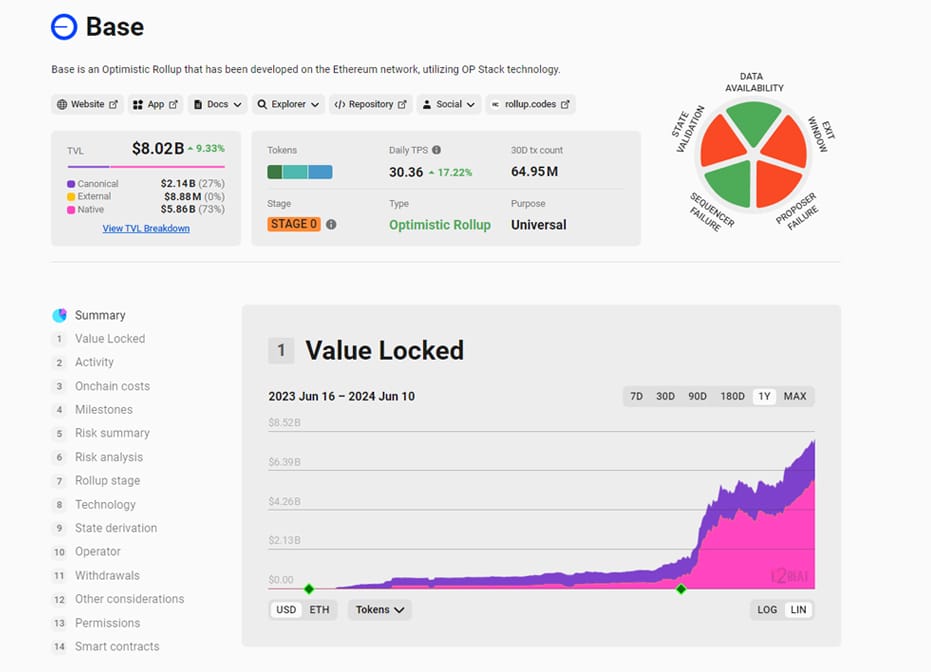
- $2.5B Total Value Locked (TVL) across DEXes, lending platforms and bridges (DeFiLlama)
- $0.06 average fee per transaction—down 40% since Q1 2024
- 28–31 TPS sustained throughput, spiking above 35 TPS during memecoin drops
- 1.2M daily transactions on weekdays, 800,000 on weekends
- 120+ memecoin launches to date
By comparison, Arbitrum’s daily throughput averages ~600,000 transactions, with memecoin share under 25%. Base’s outsized memecoin activity reflects its design for light governance overhead, near-zero friction and strategic marketing by Coinbase.
2. Dissecting the Memecoin Boom
BaseScan data shows memecoin trading volumes on Base topping $3 million/day, nearly half of all DEX turnover. Analysts point to three driving forces:
2.1 Viral Growth Loops
Every mint, swap or social share doubles as a referral. Cohort analysis for $BRETT reveals a 12% monthly retention rate—on par with early NFT sensations and outperforming many DeFi protocols. Social media chatter around “Brett Carnivals” and community-driven airdrops amplify onboarding, turning holders into evangelists.
2.2 Ultra-Low Cost Experimentation
At $0.06 per transaction, developers and traders can trial novel mechanics—deflationary burns, time-locked staking and dynamic supply curves—with minimal risk. Ethereum mainnet fees often exceed $20 for complex interactions, hindering rapid iteration. Base enables sub-$100,000 capital pools to test in real time before scaling on larger networks.
2.3 Seamless Coinbase Integration
Deep integration with Coinbase Wallet and the in-app DEX streamlines KYC, fiat on-ramps and token discovery. Over 60% of new Base wallets engaging with memecoins have completed identity verification, creating a bridge between retail meme traders and institutional products. This synergy has catalyzed cross-selling of yield-bearing products and staking services.
3. Spotlight on Base’s Top Memecoins
$BRETT – The Cultural Flagship
- Max supply: 10B tokens
- Liquidity reserves: $15M across three pools
- 30-day avg. volume: $1.2M/day
- Monthly active wallets: 8,500
- 60-day volatility: ±35%
$BRETT’s mascot-led airdrops—four rounds so far—sparked up to 150,000 new addresses in a weekend. Community-led “Brett Carnivals” (both virtual and IRL) reinforce brand identity and foster organic network effects. Institutional traders have begun deploying algorithms to arbitrage $BRETT’s volatility, further deepening liquidity.
$LBRETT – Meme Culture Meets Governance
- Staked value: $3.8M
- Daily governance volume: $450K
- Core features: Dynamic inflation, NFT cross-mint rewards, community proposals
As a “utility meme,” $LBRETT blends humor with real-world DeFi functions. Recent governance votes tackled dynamic reward curves, adjusting emission rates in response to social engagement metrics—a first for memecoins. This feature has attracted DeFi protocols seeking consumer-grade gamification.
$SPX6900 – The On-Chain Lab
- Mechanics: Deflationary mint-and-burn, anti-whale transfer limits
- Weekly governance cadence: Fast-track upgrade votes
- Developer commits (July 2025): 15 major tokenomics tweaks
$SPX6900 serves as a living tokenomics laboratory. Developers gate feature releases on on-chain performance data—enabling rapid pivots based on real user behavior rather than guesswork. This experimental approach has drawn academic and industry interest in using Base as a model for decentralized R&D.
4. Developer & Community Momentum
On GitHub, Base-native memecoin projects have logged over 200 commits since Q1 2025, with 45 core contributors. Snapshot governance forums attract 1,200+ voters per proposal, rivaling participation at established DAOs like Compound and MakerDAO. The Base Incubation Program and community grants have allocated $10M toward tooling, hackathons and partner integrations—fueling protocol composability and UX experimentation.
5. Comparative Landscape: Base vs. Arbitrum & zkSync
While Arbitrum focuses on broad DeFi apps and zkSync on private transactions, Base has carved out a niche for rapid-fire token launches and community-driven experiments. A recent Flipside Crypto report ranked Base first in monthly developer growth, outpacing Arbitrum (2nd) and zkSync (3rd). This developer momentum—and the memecoin sub-ecosystem it spawned—could inform product roadmaps across L2s.
6. Institutional Takeaways
- Token Engineering Ground Truth: On-chain experiments with burn rates, bonding curves and rewards provide real-time data to refine incentive models for larger DeFi and NFT initiatives.
- User Acquisition via Play: Memecoin hype functions as self-funded marketing, converting social media virality into wallet growth and wallet growth into fee revenue.
- L2 Product-Market Fit: Chains embracing cultural tokens can outpace those targeting only institutional throughput, proving social layers matter in blockchain adoption.
Major DeFi firms, including Aave and Balancer, are now studying Base’s datasets to optimize liquidity mining and yield strategies—validating meme-driven tactics at scale.
7. Risks & Regulatory Outlook
- Price Volatility: ±30–50% intraday swings necessitate active hedging and real-time liquidity management tools.
- Regulatory Scrutiny: SEC warnings on unregistered tokens may constrain marketing, incentivization schemes and airdrops—potentially chilling viral growth loops.
- Sustainability: Treasury-backed liquidity models remain untested through extended bear markets; capital efficiency over multiple cycles is uncertain.
Nonetheless, Base’s memecoin cohorts exhibit resilient on-chain engagement—illustrating that humor-infused tokenomics can align with professional risk management.
8. Future Outlook
What began as fringe experiments have become Base’s core growth engine. The anticipated “Base 2.0” upgrade promises sub-$0.04 gas fees, while upcoming cross-chain memecoin bridges to Polygon and Avalanche will broaden distribution. Rumors of an autumn memecoin airdrop snapshot have already driven speculative spikes in on-chain activity.
As competition heightens among Layer-2 networks, those combining cultural resonance with rigorous token-engineering are poised to lead blockchain’s next adoption wave. Base’s memecoin sandbox is more than a novelty—it’s a proving ground for decentralized finance’s future.