

Base Cementing Revenue Lead as L2 Fees Concentrate — What It Means for Ethereum Scaling
Base, Coinbase’s Ethereum Layer 2 (L2) network, has emerged as the dominant fee-earner in early 2025. On a CryptoRank snapshot taken at 00:00 UTC Jan. 14, 2025, Base generated about $147,000 in daily transaction fees—roughly 70% of all Ethereum L2 fees. Year-to-date L2 revenue through early 2025 stands at $75.4 million out of a $120.7 million total (≈62%), while Base’s decentralized finance (DeFi) Total Value Locked (TVL) has grown to $4.63 billion (≈46% of L2 TVL). This concentration of fees, value and developer mindshare on a single EVM-compatible optimistic rollup raises questions about competition, centralization risk and where builders will focus scarce user attention.
TL;DR / Key Takeaways
- Base captured 70% of daily Ethereum L2 fees ($147K on Jan. 14, 2025) and 62% of y-t-d L2 revenue ($75.4M of $120.7M).
- DeFi TVL on Base hit $4.63 B—overtaking Arbitrum’s share and accounting for 46% of total L2 TVL (L2Beat).
- Sequencer centralization: Coinbase runs Base’s OP Stack (Optimism stack) sequencer with a 7-day fraud-proof window and no native token.
- Risks and outlook: centralization scrutiny, regulatory headwinds, and competition from Arbitrum, Starknet and emerging zk-rollups.
Key Facts
- Daily fee snapshot (CryptoRank/Phemex): Base $147K vs. Arbitrum $39K, Starknet $9K, others combined ≈$15K [1][3].
- Y-t-d L2 revenue (RootData, DWF Labs): Base $75.4M of $120.7M total (≈62%) [2][5].
- DeFi TVL (PanewsLab, L2Beat): Base $4.63B (46% of L2 TVL), Arbitrum $4.25B, others split the remainder [4][6].
- Sequencer model: Base uses the OP Stack optimistic rollup with Coinbase-run sequencers and a seven-day fraud-proof window; no native token exists [2][5].
- Daily active addresses: ≈550,000, driven by DEX trading, token swaps and perpetual futures (CryptoRank) [3].
Context — Why This Matters
The shift in fee and TVL concentration to Base alters the economics and competitive landscape of Ethereum’s L2 ecosystem. Builders and liquidity providers are increasingly drawn to Base for its low fees and Coinbase’s on-ramp integration, accelerating network effects for apps already live. However, this concentration narrows the field for new projects, which may struggle to attract users and revenue on less dominant chains. At the same time, industry observers are raising the alarm about Base’s centralized sequencer model—which, unlike rival Arbitrum, remains under Coinbase’s direct control without a decentralized staking mechanism.
Methodology Note
Fee data is sourced from a CryptoRank snapshot taken at 00:00 UTC on Jan. 14, 2025. TVL figures are aggregated on L2Beat as of Jan. 10, 2025, with PanewsLab cross-checking canonical bridged assets. Year-to-date revenue estimates are provided by RootData in collaboration with DWF Labs, using on-chain fee receipts and protocol revenue streams.
Details
On-chain metrics underscore Base’s rapid ascent. Daily fees averaged $147,000—outpacing Arbitrum’s $39,000 and Starknet’s $9,000—while Daily Active Users (DAU) near 550,000 reflect high on-chain trading and contract interactions. DeFi TVL on Base has grown from roughly $1.5 billion at launch in mid-2023 to $4.63 billion today, driven by lending protocols, automated market makers and derivative platforms. According to DWF Labs, Base represents “an open stack for the global economy,” crediting Coinbase’s distribution advantages for accelerating adoption [5].
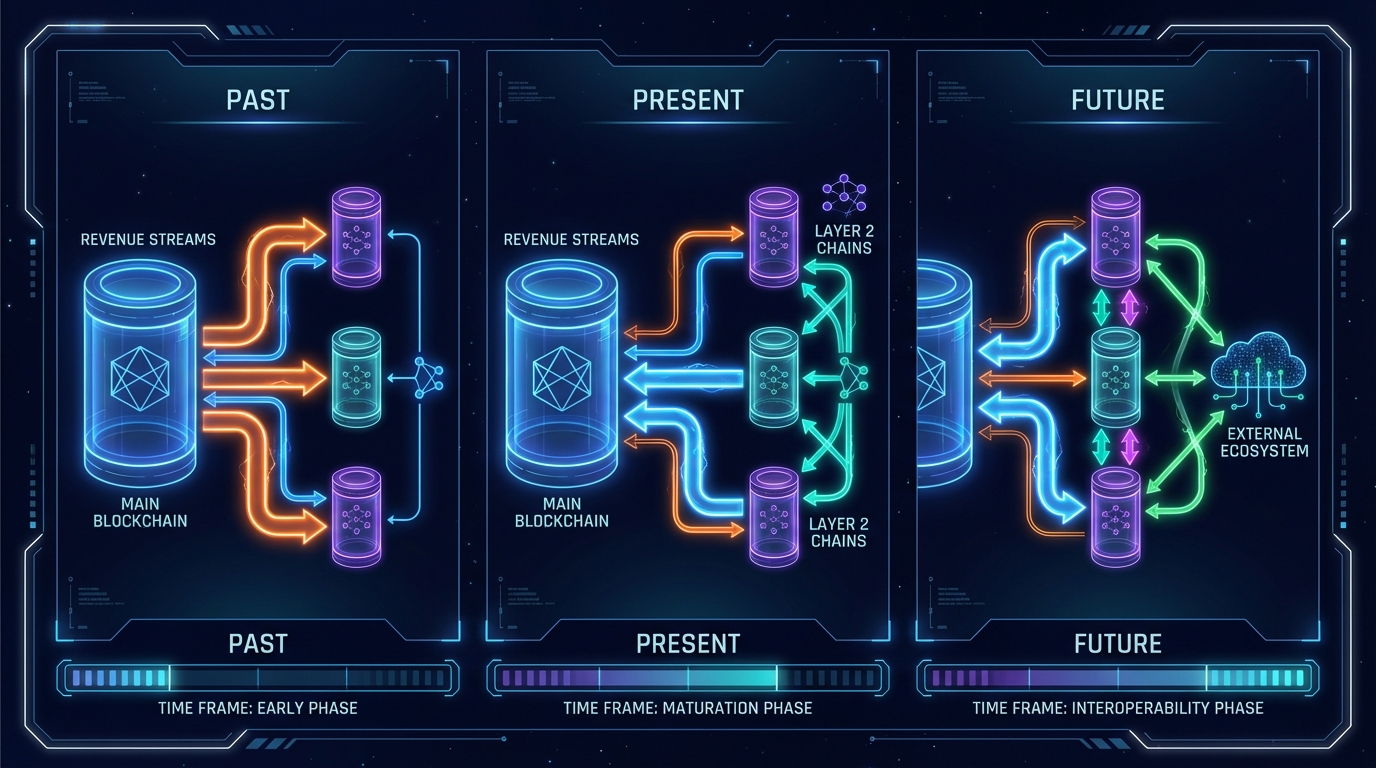
Despite a 30-fold increase in fee revenue year-over-year, aggregate L2 revenue has declined from 2024’s all-time highs. This means Base’s market share grew in a contracting environment, underscoring both the network’s resilience and the broader slowdown in Ethereum L2 activity. RootData cautions, however, that dependence on a single sequencer exposes Base to operational risks: any outage, software bug or regulatory action against Coinbase could cascade through the network.
Analysis
For developers, Base’s dominance reduces onboarding friction—fewer network integrations and a familiar Coinbase wallet experience translate to faster deployment and user acquisition. Yet this comes with trade-offs. Centralization risk is elevated: Base’s sequencer can censor or reorder transactions, and there is no native governance token to decentralize control. Regulatory scrutiny of Coinbase, particularly from the U.S. Securities and Exchange Commission (SEC), could translate into tighter oversight of Base’s operations or force architectural changes.

Competitively, Base has leapfrogged both Arbitrum and Starknet in fee capture and TVL, but it still trails in ecosystem diversity. zk-rollups such as zkSync and Polygon Zero offer stronger trust guarantees via cryptographic proofs, and specialized social or gaming chains cater to niche use cases. In scenarios where on-chain privacy or instant finality is mission-critical, builders may migrate off Base despite its fee advantage.
Background
Launched in August 2023 on Optimism’s OP Stack, Base is an EVM-compatible optimistic rollup designed for low transaction fees, fast finality and seamless Coinbase integration. Unlike many L2 networks, Base does not issue a native token, relying instead on revenue-sharing contracts and developer grants to attract projects. Its seven-day fraud-proof window balances user security with operational throughput but leaves a longer challenge period than zk-based alternatives.

What’s Next
Expect ongoing scrutiny of Base’s sequencer centralization as major projects and regulators weigh in. Coinbase has signaled plans to introduce additional node operators, but details remain unconfirmed. Meanwhile, zk-rollups continue to mature, and Arbitrum’s upcoming token-governance upgrades could narrow the gap. On-chain observers will watch TVL and fee share trends closely—any sustained shift away from Base could signal a return to a more fragmented L2 ecosystem.
Conclusion
Base’s rapid revenue and TVL growth highlights both the power and perils of concentration in the Ethereum L2 landscape. While builders benefit from lower friction and robust Coinbase integration, the centralized sequencer model raises systemic risk concerns. The coming months will show whether Base can diversify its sequencer set, withstand regulatory headwinds and maintain its lead against evolving zk-rollup competitors. Ultimately, healthy competition among L2 networks will be key to Ethereum’s long-term scalability and decentralization goals.