

Lead – Coinbase pivots Base toward institutional-grade DeFi
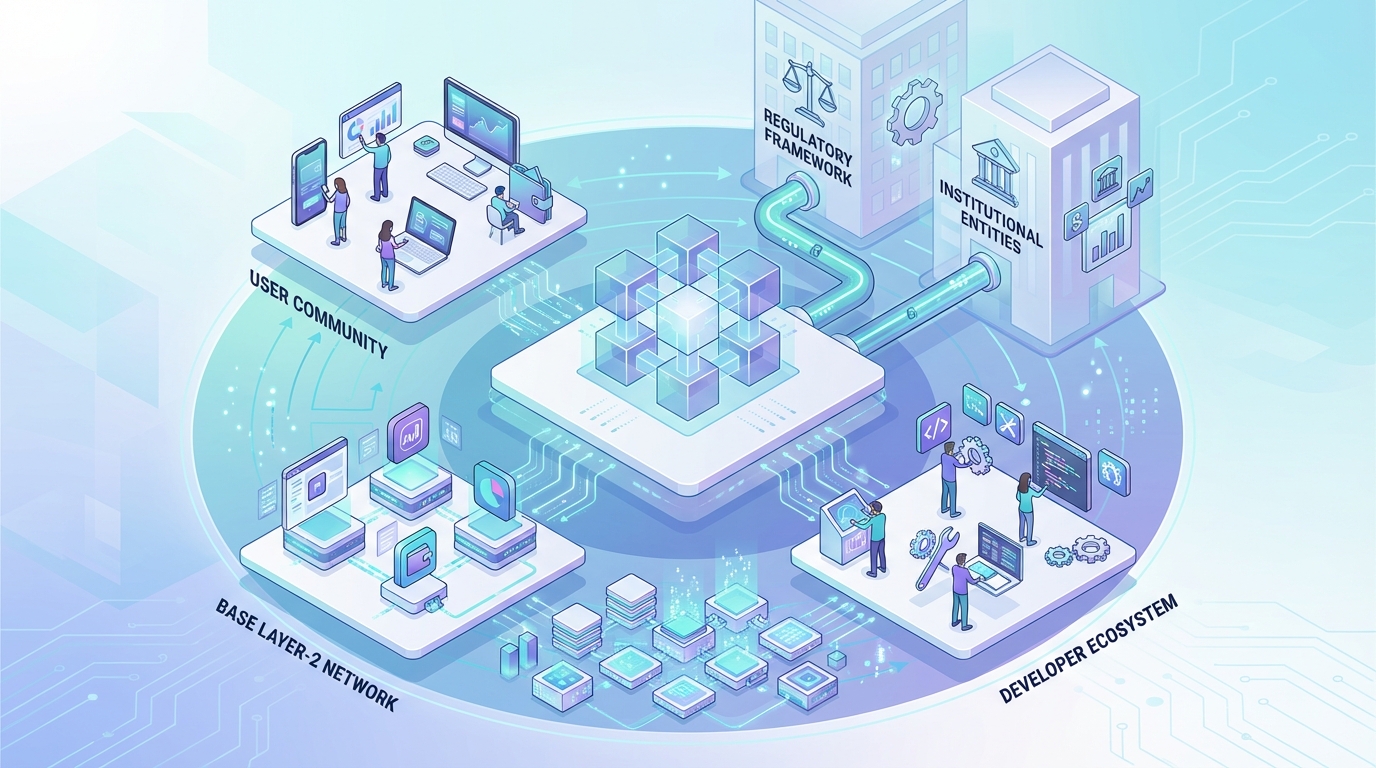
Coinbase has reoriented Base, its Ethereum Layer 2 network, toward institutional use cases in 2026, prioritizing USDC payments, tokenized assets and DeFi infrastructure. The shift accompanies a recent uptick in activity: Total Value Locked on Base reached roughly $4.2 billion in early March 2026 and daily active users have climbed to about 450,000, signaling early traction even as centralization and regulatory questions persist (Coinbase blog; DeFiLlama; Dune; BaseScan).
Key facts
- Base TVL ~ $4.2B on March 5-7, 2026, up ~18% month-over-month (DeFiLlama; BaseScan).
- Monthly transaction volume ~ $15.6B with heavy USDC share (~60%-70%) (Dune; BaseScan).
- DAUs averaged ~450,000 over 30 days to March 6, 2026; developer activity rose ~28% in Q1 2026 (Dune; BaseScan; Electric Capital).
- Coinbase controls Base’s sequencer and much of its bridge infrastructure, creating centralization and regulatory exposure (Coinbase status reports; Artemis).
Context – Why this matters
The pivot aligns Base with Coinbase’s broader “Everything Exchange” strategy to funnel institutional flows on-chain, using USDC and tokenized assets as rails. If sustained, the move could accelerate institutional stablecoin settlement, on-chain treasury management and tokenized real-world assets (RWAs), reshaping how institutional counterparties access DeFi liquidity (Coinbase research; Circle CCTP documentation).
Details
Official announcement specifics
Coinbase’s 2026 priorities emphasize integrating on-chain DeFi into its trading and custody stacks and expanding USDC rails on Base, citing new product and tooling investments, grants and AI-assisted developer support (Coinbase blog; Coinbase Ventures).
Market impact and metrics
On-chain snapshots show TVL concentrated in DEXes and lending, with tokenized assets such as cbBTC contributing materially. Monthly volumes and DAUs have risen, but Base trails larger L2 rivals by absolute volume and remains about 12% of L2 TVL market share (DeFiLlama; Dune; BaseScan).
Stakeholder reactions
Developers report increased activity and grant interest, while auditors and risk teams highlight a single sequencer operator and bridge centralization as primary concerns. Outages earlier in 2026 prompted temporary drops in activity and renewed calls for sequencer decentralization (status.base.org; downdetector).
Technical significance
Built on the OP Stack, Base benefits from optimistic rollup economics and Ethereum security; recent upgrades added native USDC support via Circle’s CCTP and improved calldata efficiency post-Dencun, boosting cost and throughput metrics for institutional flows (Optimism docs; Circle CCTP).

Analysis
Base’s institutional focus leverages Coinbase’s user funnel and USDC dominance to capture treasury activity and stablecoin settlement. Competitively, Base must balance speed-to-market with decentralization: zk-based L2s and permissionless rivals may attract risk-averse treasuries seeking stronger finality and reduced counterparty concentration (zkSync; Arbitrum metrics).
Near-term growth depends on regulatory clarity, sequencer decentralization and continued marketplaces for tokenized assets. Failure to address centralization or to expand cross-chain settlement could limit Base’s ability to convert retail on-ramps into sustained institutional TVL.
Background
Launched in August 2023, Base is an EVM-compatible L2 without a native token that uses ETH for gas. The network was designed to integrate with Coinbase’s wallet and exchange and has since pursued rapid developer onboarding and liquidity incentives (base.org; Coinbase blog).

What’s next
Watch for Coinbase’s sequencer decentralization roadmap, planned for 2026, further Circle CCTP integrations, AI tooling rollouts for developers and regulatory developments in the U.S. that will determine whether Base scales from early institutional experiments to a durable settlement layer (Coinbase roadmap; Circle reports).
Sources: Coinbase blog and research, DeFiLlama, Dune Analytics, BaseScan, Circle CCTP documentation, Optimism OP Stack docs, Artemis and Electric Capital reports (see links cited in reporting).